Tuesday, 30 October 2012

Interview #11: Philip Reeve

Philip Reeve, at home on Dartmoor
I'm very privileged to have Philip Reeve as the subject of my latest Bookengine interview.We spoke via Skype (a first for Bookengine!) - me in Cheshire, Philip at his home on Dartmoor.

Philip, of course, is the author of the thrilling Mortal Engines books. To those who have yet to savour them, they are set in a post-apocalyptic world following the 'Sixty Minute War'. Entire cities and towns have become huge, mobile vehicles - traction cities - driven by a 'survival of the fittest' system called Municipal Darwinism. This results in cities consuming one another in order to survive.

He won the Carnegie Medal for his retelling of the Arthur legend, Here Lies Arthur. His other work includes the Larklight trilogy and most recently his book Goblins was shortlisted for the Roald Dahl Funny Prize.

Originally from Brighton, he trained as an illustrator, then worked in a bookshop for a while before becoming a freelance artist providing illustrations for the Horrible Histories series among others.

The book that started it all for Philip
His artistic training clearly influenced his writing style. Mortal Engines is a feast for the mind's eye, allowing the reader to see clearly the world Philip has created.

I was keen to ask him how he created the Mortal Engines world, with its logic, rich history, cleverly woven storylines and interconnected characters.

Surely he began with an overarching masterplan?

"I don't deal in plans. Mortal Engines came about a long time ago. About 20 years ago. I was wanting to write some big adventure. I kicked various ideas about before I hit on the notion of a city on wheels. Once I got that image I started writing. I started on page one. And it went on and on. I threw many, many versions away. But I came up with key scenes, which I salvaged. And after 10 years I had a book."

There must have been an incredible amount of editing involved?

Philip said: "You work in the way you work. I can write 50- or 60,000 words and keep 10,000. I'm not an efficient writer!

"As I say, I never do a plan. I have books here I have plotted and I've never written them because I've got it all out. I don't see the point. So instead I just write and I suddenly find I've written half a book.

"I find it quite easy writing in a visual way. It took lots of work, of course. I can usually see things pretty easily. I just have to write it down then."


... and a wonderful place it is, too!

I'd imagined Philip had planned Mortal Engines as a sequence of novels from the start.

Not so, he told me.

"At the end of the first book I thought I had tied up all the loose ends. So I picked away at it. And I noticed there were one or two things to be expanded on."

Some have described his work as steampunk.

He said: "I've always loved contraptions and strange Victoriana. I loved Oliver Postgate, The Clangers, Chitty Chitty Bang Bang. Stuff like that. A sense of the past as a playful place.

"I was a Lord of the Rings fan as a boy. I didn't really like sci-fi growing up. I didn't like Doctor Who, I found it too scary. I loved fantasy, Tolkien and Alan Garner. I tried to write my own version of those books.
The first Mortal Engines prequel

"I liked building worlds, mapping them and creating names. Mortal Engines developed straight out of that.

"Star Wars introduced me to sci-fi and showed me it could be rusty and dusty and could draw on history.

"I've written three prequels to Mortal Engines. There's to be a fourth prequel. But it's going to be a year or two before I do that."

I loved Philip's wit and playfulness in the books, the play on words - Tunbridge Wheels is a favourite!

"Well, I think of myself as a comic writer. Goblins is humorous. It's a story like the others, though it does have lots of jokes along the way."

Goblins has garnered interest from filmmakers and there are plans for a movie by the team that made Coraline and the recent ParaNorman. It is a rollicking comic fantasy, sparked after Philip read Tolkien to son Sam at bedtime. He began writing his own, humorous story and shared instalments with Sam each night.

A film of Goblins is planned
"I have done a second one and it would be nice to do it as a trilogy, but it depends whether my publisher wants one," he said.

He has lived on Dartmoor for around 15 years. I was interested to know whether his home influenced Here Lies Arthur, which shows the dark side of Camelot.
"I did a lot of walking around Dartmoor. I do a lot of walking anyway, and sketching.

"I tried to make it feel very earthy. These people are living in nature, but not in a nice way. It's hard and it's cold. The changing of the seasons are important to them."

Recently, Philip has collaborated with illustrator Sarah McIntyre (interviewed for Bookengine in September). He's written two stories under the umbrella title Seawigs. Sarah is working on illustrations for the first, Oliver and the Seawigs.

"It's a sea adventure with mermaids. The second is set in space. It's not a series, they are standalones.

"It's out of my hands now and on Sarah's drawing board. Her illustrations look phenomenal."

Meeting his fans
Did he never want to illustrate his own work?

"I would have loved to have been a painter, a landscape painter.

"But I don't have the ability, so I write them instead."

* Many, many thanks to Philip for taking the time to speak to me (by Skype!) from his Dartmoor home. His website is packed with great stuff. And make sure you visit his blog too.

Tuesday, 9 October 2012

Interview #10: Kate Maryon

 "The key to writing is to find your voice. And often you find your voice when you look to what was the most difficult part of your life."


Kate Maryon

Kate Maryon offered me this brilliant piece of advice right at the end of our interview when she asked me whether I was a writer. I told her I had long been a writer but felt I hadn't yet found my voice. I thought a lot about what she said after I put the phone down and I realised she was absolutely right. Writers should face up to awkward, painful events and tell the truth.

If ever there was a writer who followed her own advice, then Kate Maryon is that writer.
Her books explore themes such as isolation, loneliness and separation. She may not describe it as such, but writing could be a form of therapy for her.

"I always knew from when I was young that I could write. I used to write, with a pencil and pad, pages and pages of scribbles.

Baby Kate
 "I had a traumatic childhood and I think I was trying to express that somehow."

Kate's father was violent and cruel towards her and her siblings and mum. He'd had a troubled childhood of his own.

"When he met my mum and she got pregnant with me his anger erupted. He burned everything and threw everything out of the house. He would take a puppy or a kitten out and shoot it if it did a wee in the house."

One of Kate's strengths as a writer is her understanding of what makes people tick. And she can see why her father behaved the way he did.

"My father was born after my grandparents lost a three-year-old. He was born into an atmosphere of grief and panic. He was a wild little boy, obsessed with nature and animals. When he was 15 he went into hospital with tuberculosis and didn't come out until he was 20.

"He was full of rage."

Her first published novel
Witnessing that rage ultimately led Kate to a realisation: "I became aware of the continuum of life and he was part of it. But he was not to blame."

Speaking to Kate and looking at her books and the themes they explore, one is struck by her compassion for others and a sense that she is somehow trying to heal those around her.

So it is no surprise to learn that she is a homeopath. Since 1996 when she first qualified, she has worked with thousands of people. "My particular talent is supporting clients in unravelling the emotional and psychological patterns that are keeping them from living the deeper, truer expression of themselves," she says on her website.

She was married young and had her two children when she was 24 and 25. Her writing was put on hold, but she read lots with them. She became a writer once more years later when she had an epiphany driving through Frome, Somerset, where she lives.

She joined a creative writing class.

"It became evident that I could write after a week and the class was very supportive - we read and shared things. As the weeks went on I stopped doing the class homework and started writing a novel. It didn't occur to me it was a children's novel."

She sent the book out to the world and after the usual rejection she was signed up by agent Eve White and publishers HarperCollins.

She relished the editorial process of working with her editor and Shine was her first book to be published, in 2009, although it wasn't her first written book. Three more novels, Glitter, A Million Angels and A Sea of Stars followed in quick succession.

"I learned something new with each book. My weak spot is plotting. I am very good at emotional content and understanding characters."

On her author website, she explains: "My books are about ordinary girls, like you, who find themselves faced with an extraordinary real life situation. I’d like my characters to take you on a journey, a kind of exploration so you get curious about life, so you end up thinking… How would I feel if this thing happened to me?

The novel Kate sent to my daughter
"What would it be like if my mum suddenly got sent off to prison? How would I cope if my dad lost his business and we had no money left? How far would I go to bring my dad back home? What would it be like if my family adopted a child?"

She begins writing when a character "leaps" into her imagination. "I ask them lots of questions about themselves. They will reveal what is going on for them. There's a point where the character starts writing their own story."

She's working on a novel at the moment about a girl living on the streets of Manchester. To help with research, she has been talking to Andy McCullough of homeless charity the Railway Children. "When he was 11 he packed a bag and a teddy and lived on the streets." She said she doesn't want to romanticise homelessness and Andy has busted a few myths for her, such as the idea that homeless people eat out of bins - he told her they don't, they still have pride.

Meeting her young readers on school visits is important to Kate. She will talk to the youngsters about her experiences and leads them through workshops, encouraging their own writing and self-confidence.

"I do have a mission," she told me. "My mission is to bring about an awareness of how we relate and particularly how parents relate to their kids."

Kate worked in diverse fields before she was a homeopath and author. She's been a nanny and a waitress. She was also  a dresser for a West End theatre and at the BBC, where she worked on EastEnders, Breakfast TV and Grange Hill. Perhaps she might find herself back in the world of television with her books, I suggested.

"CBBC looked at Shine for a  while. There's that slot around Christmas that Jacqueline Wilson seems to snaffle," she said. Not that she holds a grudge against the Tracy Beaker author. Wilson and Cathy Cassidy are authors she looks up to. If a film or TV series were made of one of her books, she would love to see director Ken Loach behind the camera.

Kate is happy and fulfilled, despite her traumatic childhood
As we brought the interview to a close, Kate asked if my nine-year-old daughter had read any of her books. I said she hadn't but explained that she had read several Jacqueline Wilsons.

A couple of days later a parcel arrived for my daughter. Inside was a copy of A Million Angels with a lovely personal inscription from Kate. My daughter was thrilled.

Kate Maryon truly knows how to touch people.

* My thanks to Kate for speaking to me. Her author website is here. There's loads to read and do there, including joining her fan club. If you are interested in her work as a homeopath, go here.

Her page on her agent's website is here.

If you want to find out more about homeless charity Railway Children and the inspiring work of Andy McCullough, you should click through here.

Thursday, 4 October 2012

Bookengine guest #1: Miriam Halahmy

Welcome to the inaugural Bookengine guest blog.

I'm very privileged to welcome Miriam Halahmy, the Carnegie Medal-nominated author of three powerful YA novels, Hidden, Illegal and Stuffed. Her work has garnered rave reviews from the likes of Wendy Cooling and Nicolette Jones.

My thanks to her for taking the time to pen this post. Her website is www.miriamhalahmy.com
Her publisher is Meadowside Books, whose website is www.meadowsidebooks.com


Miriam Halahmy and some of her teen readers


Tips on writing gritty teen fiction without giving a lecture.


My books cover some of the most controversial issues of our times including human rights, immigration, racist bullying, dysfunctional families, crime, self harming and mental health issues. I have been interested in social and political issues from childhood. It is inevitable therefore that my fiction will reflect my interests and passions. So how can we weave gritty issues into a novel without sounding like a Humanities teacher reading from a text book?

Here are my top ten tips :-

1. All writing revolves around the characters. You can’t have a plot on an empty stage.

2. Don’t let your research bog down the text. No-one wants to read social work reports. Keep your information in the background.

3. Controversial Y.A. fiction doesn’t work as a soap box – it works the way all good fiction works with characters that stand up and stand out on the page.

4. Well written fiction can be far more effective than a classroom lesson or a history book. My novel Hidden has themes of immigration, racism and human rights. I have a gang calling an Iraqi boy ‘paki’ and ‘terrorist’ but then I deconstruct this awful language in the story. The impact on teens can be quite profound. A twelve year old girl wrote to me saying, “I didn’t know we had immigrants in England."

5. It is not the issues which will keep your readers page-turning. It is the characters and their journey. Make sure your characters are layered, with strong back stories and everyday problems to deal will while they confront the big issues.

Writing in a Costa coffee shop

6. Equally, don’t shy away from controversial issues because of a fear that young readers aren’t ready. Controversial fiction helps young people to form independent opinions. One thirteen year old told me after reading Illegal, “I like reading about lives which are so different to mine.”

7. Don’t forget humour. It can be one of the best ways to tackle serious issues. One of my favourite novels, Two weeks with the Queen by Morris Gleitzman, deals with leukaemia, death, aids and gay love. But it is laugh-out-loud like all of Gleitzman’s books. Humour is a very powerful tool for dealing with gritty issues.

8. Keep it clean please! The three sss – slang, swearing and sex, often become stumbling blocks for writers wanting to deal with gritty themes. My two novels keep slang to the minimum, avoid swearing and only allude to one sexual episode. The decision on how much of the three sss to use is for the individual writer to decide, but it would be wrong to feel that you must use them to write gritty fiction.


The poster says it all

9. Is there anything you can’t write about? According to the teenagers; no. I have asked them directly and they all say, Write about anything you want. Ultimately, the writer has to decide where the boundaries lie for them and yes, we do have to be aware that some gate-keepers might not be happy but the decision is all yours.

10. Write the book you want to write whatever genre, that’s the only way you will be remotely happy as a writer.

Y.A. fiction is at the cutting edge of contemporary fiction in the UK today. Our job is to write the best books we can but let’s keep the narrative alive and engaging. No-one wants to be lectured to when they settle down for a good read.

Miriam Halahmy

www.miriamhalahmy.com


Friday, 28 September 2012

Interview #9: Julie Fulton

Julie Fulton has Mersey Sound poet Brian Patten to thank for setting her on the path to becoming a published author.

In 1974 when she was ten he chose a poem she'd written for inclusion in a small anthology of children's poems for the Little Missenden Festival, in Buckinghamshire, where she lived.

Julie Fulton with a protective arm around her first
book, Mrs MacCready Was Ever So Greedy

"It was called I Like... and I got to read it out at a big presentation and meet the famous Mr Patten himself. I have had a love of poetry ever since and still tinker with the odd ode to this day."

These days, Julie is the recently published author of rhyming picture book Mrs MacCready Was Ever So Greedy. Her publishers, Maverick Books, are so pleased with her work they've asked her to create a series of 'Ever So' books, all set in the fictional village of Hamilton Shady. Tabitha Posy Was Ever So Nosy is the next one, due to be published on January 28 next year. Julie hopes she will write one a year.

Although she is these days known to the world as a writer, Julie's background is in music and teaching.

She studied music at university, became a school teacher and eventually became a self-employed music teacher.

She had always loved writing and stories, and took great pleasure in reading to the children in her class when she was a school teacher.

Julie's first book
Once you realise this it's easy to see why she's drawn to rhymes and rhythms. Her influences are timeless rhymesters Edward Lear, Dr Seuss, Ogden Nash, Hilaire Belloc and Spike Milligan.

"I've been told my stories are like Belloc's - they have a subtle, underlying moral. I always loved rhymes and poetry and I've always written rhyming poetry. I really enjoy rhythm."

Of Mrs MacCready and her breakthrough as a published author, she said: "I thought it was just a nonsense poem. I wrote it for a writers' group homework. I don't know where it came from, it all tumbled out in an hour. But someone said it's a picture book."

She decided to send it to publishers and was picked up by the second one on her list - Maverick Books.

...and the second in her 'Ever So' series, which will be available next January
The publisher commissioned Jona Jung, a Polish artist, to do the illustrations. It has proved a remarkable collaboration as Jona does not speak English. "She uses Google Translator when she emails me, which makes for some interesting emails! I don't know whether she translates my stories the same way or not. But her illustrations are wonderful and she adds something extra of her own, too."

The book is aimed at children aged four-plus. It's the tale of Mrs MacCready, of Hamilton Shady, who likes to eat. And eat. And eat. Until, eventually, she... well that would be giving the end away. But it's certainly unexpected.

Julie entertains her young fans
One of the things Julie loves more than anything is going into schools to give readings to children and help them to do their own writing. She has a ready-made audience, too, at her local village primary school where she frequently pops in to 'road-test' works in progress.

"It's really useful to be able to do that," she told me. "I always try to put a long word in. In Mrs MacCready it was 'succulent'. The editor wanted to take it out, but I put my foot down."

And so the word remains in the text...

Mrs MacCready was ever so greedy
she did nothing else but eat.
Fish fingers and chips, apples with pips,
plates full of succulent meat.

Julie has narrated Mrs MacCready for the Nook, an e-book reader for the North American market. "I absolutely loved doing it!"


A page spread from Tabitha Posy

I asked Julie if she wanted to write novels for children and, sure enough, she told me she was currently editing a book for children aged eight and over. It's set during the Second World War and is the tale of an 11-year-old evacuee named Susan. Julie has not been able to place it with a publisher yet and she's even considering self-publishing.

Whatever direction Julie Fulton's writing takes in the future I'm sure it will succeed as she's 'Ever So' talented.

* Many thanks to Julie for talking to Bookengine about her work. Her website is here. Visit the website of her publisher, Maverick Books, here.

Monday, 24 September 2012

Interview #8: Sarah McIntyre

Sarah McIntyre
Growing up in Seattle, Sarah McIntyre was obsessed with Egyptian tomb paintings and wanted to be an archaeologist.

"I chose my university because it had a good archaeology programme. But at the first lecture I went to, we spent an hour and a half discussing some fireplace lintel, and I thought, hmm, I'm not sure this is what I want to do for a living. It's not exactly Indiana Jones."

Finding herself at a crossroads, Sarah decided she wanted to travel instead and signed up for a degree in Russian.

It would prove a momentous decision for someone for whom serendipity has played a major part in her life and career path.

Today Sarah is one of the most exciting picture book illustrators, comic strip artists and authors around. She has collaborated with the likes of Giles Andreae and Philip Reeve (more of which later) and is the creator of the brilliant Vern and Lettuce strip cartoon in DFC, now Phoenix, comic.

Sarah's collaboration with Giles Andreae

I was hugely excited when she agreed to speak to me, following my interview with Gillian Rogerson, one of Sarah's collaborators.

So how did throwing down her archaeology trowel in favour of a plane ticket to Russia lead to such an illustrious career?

She spent a year living in Russia as part of her course and stayed for a further year afterwards. It was here that she met her British husband, who was working at the British Embassy.

After her studies she worked on a newspaper as a copy editor, writing headlines and captions. 

Sarah provided the illustrations for
Gillian Rogerson's brilliant
Princess Spaghetti books

But while she loved the newsroom buzz, she was put off by the way the editor would shame people in front of their colleagues, once making someone cry, and when she tried her hand at journalism, one of her first articles divided the expatriate community, filled the editor's inbox with letters of complaint, and a banker sent a courier around to the office with threats of a lawsuit.

"I thought, I don't want to do the sort of job that just makes people angry with me."

She and her husband decided to move to the UK, London to be precise. "I always thought it would be cool to live in London."

Here she and some friends ran an art gallery for six years. Again, Sarah didn't feel she fitted in.

"I didn't find fine artists to be terribly friendly people, and I was always feeling back-footed, not having enough grasp of art theory. And then I just got bored by fashionable people being obsessed with their image, and minimalism, all this fuss over exhibitions where there was almost nothing to look at.

"Children's books was such a welcoming harbour. People who make picture books are genuinely nice people, and I think it's just as complicated making something that's understandable to both children and adult, and far more fun."

Her Vern and Lettuce comic
strips are now a book

She took evening illustration classes with children's book illustrator Elizabeth Harbour. "Her teaching was so, so good, and even after the classes ended, a bunch of us would still meet up to talk about and critique each other's work. I felt THIS is what I should be doing."

Drawing and painting had always been a passion, but she never considered it as a possible career, always believing she would get a 'proper' job.

At an early career low point, she interviewed to become a rigger on the Cutty Sark, although the contract was for 12 years and if she quit before then, she'd have to pay back all the training fee. Perhaps fortunately for children's books, Sarah didn't get the job, but the Cutty Sark hired her instead to work as Ship's Illustrator. 

Her true path was beginning to open up for her. She went back to art college and did a part-time MA over two years studying under Janet Woolley.

"I guess it was round that time I finally figured out what I wanted to do."

 With a few US-published children's picture books under her belt, Sarah took a fateful step when she went with her portfolio to see children's publishing supremo David Fickling, whom she'd heard was looking for comic strips. She was signed on the spot to do a weekly strip cartoon for the David Fickling Comic (now recast as the Phoenix). "They said, while you're here, would you like to illustrate a picture book for us?"

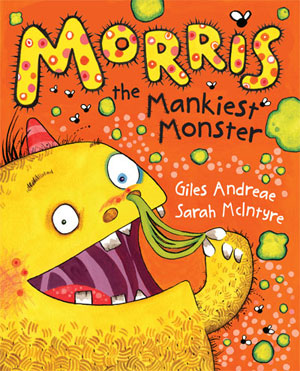
The strip cartoon became Vern and Lettuce about animals living together in a tower block. The picture book was Morris the Mankiest Monster by Giles Andreae.

A peek behind the scenes!
Her dual career in children's picture books and comics was well and truly under way.

She has also illustrated books by Anne Cottinger and the Princess Spaghetti books by the wonderful Gillian Rogerson (see my Bookengine interview with her here).

"Working with Gillian Rogerson on the Princess Spaghetti books has been great fun. She's rather quiet as a person, but then she's bursting with this rollicking sense of humour."

These days Sarah makes comics and picture books in a former police station in Deptford, sharing the studio with three other artists. "It still has the police cells and is haunted," she laughed.

On the day I spoke to her, Sarah was working on illustrations for a really exciting new project - collaborating with Mortal Engines author Philip Reeve.
An early rough for Oliver and the Seawigs,
a collaboration with Philip Reeve

They met at the Edinburgh Festival where they chatted about drawing (Philip studied art before he became a writer and earned a living initially doing illustrations for Terry Deary's Horrible Histories books).

They kept in touch, encouraging each other to post a daily picture on their respective blogs - Philip of Dartmoor where he lives, Sarah of Greenwich Park. They became good friends and, being creative people, naturally were drawn to collaborate with one another.

Sarah has illustrated a four-page story for Philip's website and a short story of his, In the Bleak Midwinter.

But it was when they had an idea for a sea adventure story that they landed a four-book deal with Oxford University Press. Oliver and the Seawigs will come out next autumn. They've allowed themselves room for more play, as each book will be a completely different story with its own set of characters, but collected together as a sort of McIntyre-Reeve library.

I asked Sarah if she harboured ambitions to work in film or television. But she said she was keen to continue creating beautifully crafted books.

"I like to leave the future open. I love printmaking and like to see where it takes me. 
A more worked-up version of the
scene from Oliver and the Seawigs
"I am excited about e-books. They're something different. I think they will be awesome in the future. These are early days. Some of the apps for e-books are not well developed yet. But whatever e-books are, they are different from books.

"Having said that. If you drop a Kindle in the bath... well, that's not a problem with a traditional book!

"I'm not sure how children's picture books will adapt as e-books. Picture books are like a theatre opening up in front of a child. They are a world of wonder that a parent can share with a child."

So what is next for Sarah?

"I've illustrated Superkid by Claire Freedman, author of the Aliens Love Underpants books. It's about a kid who's a superhero. That's done and is being printed.

An inked up illustration from
Oliver and the Seawigs
"I also have other contracts with David Fickling for books I've written myself and ones written by my friend David O'Connell."

Although she professes not to want to get too busy, she may have to get used to having a very full diary as demand for her work intensifies.

* Many thanks to Sarah for chatting to me. Her fabulous website, Jabberworks, is here. Her equally wonderful blog is here. If you are interested in drawing, illustration, comics and good old artistic craftsmanship, scratchy metal nibs and jet-black ink, then both these sites are veritable gold mines. Once you've visited them, you'll be there for hours! Enjoy.

Do you plot or are you seat-of-the-pants?


Please take a look at my guest post at The Edge, the blog of the brilliant collective of writers of the same name who write cutting edge teen fiction.

Thanks to Bryony Pearce and Dave Cousins who invited me to write a contribution. It just goes to show what a welcoming and encouraging bunch children's authors are!

Click here to read the blog.

Friday, 14 September 2012

Interview #7: Kim Donovan

It seems the world of mainstream publishing is in a panic over the advent of e-books and the power of social media to reach readers.

Author Kim Donovan, publishing pioneer
Many publishers and literary agents are worried their days are numbered, fearing a similar fate to record label bosses who are now shaking their heads wondering how on earth they allowed the music business to slip through their fingers.

Writers now have a golden opportunity to go it alone. And to make it big in a way that was not previously possible. No longer is there a gatekeeper barring their entry to the world of publishing.

We’ve heard about Amanda Hocking, John Locke, Kerry Wilkinson and, most famously, E L James’ Fifty Shades series, and their go-it-alone gold rush stories.

Well, let me tell you a story about another publishing pioneer. Someone who is bravely hacking her way through the jungle of children’s book publishing and whose path may well be the one in which others follow in the future.

Let me introduce Kim Donovan, author of St Viper’s School for Super Villains and one of the creative minds behind the independent publishing collective Electrik Inc.

She told me: "I’m one of the co-founders. We’re a collective of children’s writers who have joined forces to publish our own books to a professional standard. We all have MAs in creative writing from Bath Spa University.

"Author co-operatives are brand new in self-publishing and as far as we know there is no other group like our one specialising in children’s fiction in the UK."

Brave new publishing
collective Electrik Inc
(note the switched
'k' and 'c' in the spelling...
 now that's neat!)
St Viper’s is the first book to be published with an Electrik Inc logo. It is aimed at seven- to nine-year-olds.

"One of the reasons I wrote St Viper’s was that I couldn’t find enough good books at the right level for my son when he was between seven and eight years old.

"It’s a hot topic at the moment."

She quotes from the latest issue of mslexia, which says teachers in three quarters of the UK’s schools worry about boys’ reading. Apparently, last year 60,000 boys failed to reach the expected reading level at age 11. The National Literacy Trust’s Boys’ Reading Commission found 62 per cent of boys would rather watch TV than read, compared with 45 per cent of girls. And nearly a third of boys said they couldn’t find books that interested them.

Mmm, worrying indeed.

Kim's son Christopher was an advanced reader when he was seven or eight. He soon found Horrid Henry, Astrosaurs and Jeremy Strong's books too easy, but the Michael Morpurgo books his friends were reading to bridge the gap proved too sad for him. Kim wasn't keen on formulaic, team-written books like BeastQuest. If they helped reluctant readers to pick up a book, then fine, but she found other parents agreed with her that booksellers could fill their shelves with much better stories.

It was this insight that led her to write the first St Viper's book, inspired by her son's love of super heroes, which she turned on its head to come up a school for super villains.

The book has had a great response from children, parents, teachers and booksellers who all shared her misgivings that this crucial age group was poorly served. Kim thinks the market has improved since she first wrote St Viper's.

Kim’s journey to become a crusading children’s author and publishing maverick is an interesting one.

Her background is in the health service. She has worked as a midwife, a nurse and as a hospital manager, where part of her time involved writing health strategies.

Although she always wanted to be a writer, this wasn’t quite what she had in mind. She signed up for an MA in creative writing for young people at Bath Spa University. She also did work at publishers Chicken House, reading the manuscripts from the slush pile. During her studies she was encouraged to write realistic teen fiction and she was signed by an agent at PFD on the strength of her MA work. Sadly, she never saw any of her work published. Her hopes and dreams were dashed when PFD closed its children’s list.

Many people would have been crushed. Not Kim. She began to consider doing things herself.

Meeting like-minded writers Janine Amos, Jenny Landor and Kay Leitch led eventually to Electrik Inc.

"We are not self-publishing, here," she told me. "We edit in-house - no one ever edits their own book - and we pay for illustrators, graphic designers, ebook formatting and printing ourselves.

St Viper's School for Super Villains by Kim Donovan
 "We then do the publicity and distribution ourselves. It’s hard work, but it’s exhilarating because we keep 100 per cent control."

They plan to publish their books both as print versions and e-books.

Kim believes Electrik Inc is a taste of the future for writers. She doesn’t think mainstream traditional publishing houses will disappear altogether as their distribution power will always be needed. But she thinks authors will be expected to do most of their own publicity via social media outlets like Twitter and Facebook.

I wish Kim and Electrik Inc the very best of luck. I think children’s authors of the future will one day look back and thank them.

And I can confirm St Viper’s is a great read and a beautifully produced book. I look forward to reading more in the series.

* Thanks to Kim and Electrik Inc for speaking to me and sending me a review copy of St Viper’s. Please visit their website, which is absolutely jam-packed with information about their venture. There are some great blog posts about the trials and tribulations of setting up and running an independent publishing collective.